






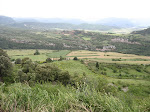













I visited Rennes-le-Chateau last summer and walked the steep three mile path up the hill from Couiza several times. I had studied the area in detail, and planned a ten day stay at a B&B in a house from 16oo. But when I left I felt that I'd barely gotten my feet wet in an ocean of mysteries. The charming tower Magdala, which Sauniere built at his humble rectory turned estate, symbolizes something I felt as a breathing pulse in the Languedoc landscape.
The first floor room of the tower is furnished like a library. It is small, only about ten by ten feet along the floor, but the room is charming. It's easy to picture the studious priest seeing his favorite book through the glass, before opening the cabinet door of the tall book shelf. He is taking out a leather bound volume and sitting down in an armchair by the fireplace. Or maybe Marie, his housekeeper, friend and companion, would join him during the day, and sit down in the window seat, near the draperies, and look out over the landscape, before opening her text to discuss it with him. To me the little library symbolizes a collection of knowledge, and a desire for learning.
But wait, there is something missing here. The space is too small for the vast volumes the good priest devoured in his time. The cute library is almost too obvious as a focal point proving his engagement in proper religious studies. I walked around the garden with the green house and the tower. They make the ends of the wall he built at the steep mountain side where he could get the best view of the breath taking countryside. I can see him as he walked his morning walks and sat down in the sunshine with another script to study.
Or is this, like so many other things in this area, a carrot, a red herring, a visual effect concealing something else. If so, I fell for it, for a while.
I look underneath the elaborate staircase going from the top of the stone wall down to the orchard and flowers. It looks like there are plenty of opportunities to hide an entrance you would want to conceal. Maybe a hidden tunnel to the crypt underneath the church which is now sealed off with concrete? Someone has apparently thought of this before and dug there without results.
Maybe I'm just a tourist looking at the most obvious solutions, which other people have checked a hundred years earlier. Maybe I'm the country mouse going wow...to everything I see.
Is this the way the Languedoc is hiding it's secrets? There are lovely things to explore on the surface, that will keep you from looking deeper, asking better questions, milling over the stories in your mind and allow new solutions to appear?
The secrets of the Cathars, of the Templars were so intangible, so etheric. We still seem to be looking for treasure, for the magical object that solves it all. What if their wisdom was of a different kind? What do we know about the elaborate teachings of martial arts masters? There is no ancient object to dig for, even though the teachings has been concidered a hidden cultural treasure for centuries. But there sure is a treasure trove of knowledge, techniques and inner wisdom to learn. And luckily, there are still masters in this art form that has the old wisdom and are willing to teach.
Is everything lost from the Cathars? Or is it so well hidden we have to recognize the carrots and dig deeper?
Wencke.
Wednesday, June 25, 2008


Tuesday, June 10, 2008
The symbol of the snake.
Are we still scared of snakes? Are we still afraid of acknowledging this power symbol of the Goddess from ancient times? Did St.Patrick effectively drive out the snakes from our consciousness? We know Ireland didn't have any problem with snakes, but had an impressive culture honoring the Goddess and nature. They're gone, and so is apparently our connection to a time when men, women and nature worked in harmony.
If you go back to prechristian times, the feminine was honored in various cultures around the Mediterranean and in Ireland. The image of the priestess holding a snake in each hand was well known, and revered. People of our time are dreaming of snakes. The Goddess is returning, and it is about time that we welcome her.
The symbol of the snake calls for your own inner power to be expressed. If we want to get in touch with the Goddess within, we have to be willing to deal with our own incredible power surging through our body. This does not express itself in gentle, sweet, velvet interactions. This power functions more like a snowplow in front of a fast moving train. It will clear your system of wimpy indecisive thoughts. It will clear your life of situations and people who do not support the purpose you were born to serve.
This is powerful stuff. It is love at its most impressive. Love for the cause, love for life. Love that protects with a flaming sword. Love that cuts through a lot of mush to get to the essence of its purpose.
The snake is a flaming sword. The sword that can also become the snake slithering on the floor scaring Pharaoh enough to let the Israeli people go. It is the twin snakes of the caduceus, showing us how the Ida and Pingala forces twine around our spine, meeting at each chacra power point, creating places for us to balance, to clean, to clear. To eventually let the power of the snake flow unhindered.
Maybe this is a power to be scared of. Maybe it is too much for our cushy selves to deal with. It is demanding. It is not pretty. It does not come across as gentle and sweet and everything nice.
Nevertheless, whether we like it or not, the Goddess is returning. And she's challenging us to not be afraid. To pick up our snake. And to wield it's incredible power.
Wencke.
If you go back to prechristian times, the feminine was honored in various cultures around the Mediterranean and in Ireland. The image of the priestess holding a snake in each hand was well known, and revered. People of our time are dreaming of snakes. The Goddess is returning, and it is about time that we welcome her.
The symbol of the snake calls for your own inner power to be expressed. If we want to get in touch with the Goddess within, we have to be willing to deal with our own incredible power surging through our body. This does not express itself in gentle, sweet, velvet interactions. This power functions more like a snowplow in front of a fast moving train. It will clear your system of wimpy indecisive thoughts. It will clear your life of situations and people who do not support the purpose you were born to serve.
This is powerful stuff. It is love at its most impressive. Love for the cause, love for life. Love that protects with a flaming sword. Love that cuts through a lot of mush to get to the essence of its purpose.
The snake is a flaming sword. The sword that can also become the snake slithering on the floor scaring Pharaoh enough to let the Israeli people go. It is the twin snakes of the caduceus, showing us how the Ida and Pingala forces twine around our spine, meeting at each chacra power point, creating places for us to balance, to clean, to clear. To eventually let the power of the snake flow unhindered.
Maybe this is a power to be scared of. Maybe it is too much for our cushy selves to deal with. It is demanding. It is not pretty. It does not come across as gentle and sweet and everything nice.
Nevertheless, whether we like it or not, the Goddess is returning. And she's challenging us to not be afraid. To pick up our snake. And to wield it's incredible power.
Wencke.
Saturday, May 31, 2008
The medical students at Montrose Beach.
I live in Chicago, and I walk along the lake nearly every day. Tonight, I met a flock of medical students who were grilling at Montrose Beach. They invited me to a piece of chicken, and we started talking. It quickly came out that I'm a writer.
When the cook heard what I was writing about, he called for his friend who studies theology and introduced me. These young people are eager to hear a new viewpoint. They have open ears for different information than what they have been fed. First they asked if I thought everything in "The Da Vinci Code" was true.
I admire Dan Brown for having started the discussions. The actual facts about Mary Magdalene and Jesus are few and far between. Very little passes our tough criteria for being given the approval stamp of "truth". (Curiously, many things in our history books are quite questionable, but have passed as true for years.) When it comes to what is "true" of the Biblical stories, there isn't really a whole lot to build a case on, for or against. There are many possibilities of what might be the truth. It depends on where you look for facts. It depends on what credence you give to stories told by different authors, who all claim their portion of truth. It depends of what depth you are looking for. There are many ways to build a story.
When I started writing "Rituals in Sacred Stone", I researched the time frame of Jesus and Mary Magdalene. What was happening politically? What religious beliefs and what mythology were in people's consciousness? What education were these two powerful people likely to have? From what schools? What background did they have that made them so respected?
What I found astonished me. The more I read, the more I researched and traveled, the bigger my peephole became, looking into their culture. I found a society brimming with life, with interactions with cultures from all over the known world, which was quite vast at their time. In year zero, the Roman Empire had been in function for several hundred years. Alexander the Great, before the Romans, had discovered India. Alexandria was the biggest city, the New York of their time, with commerce connecting them to the rest of the world. The only thing not included was America. They were aware of different religions, languages, philosophical ideas, and had studied architecture styles in detail. Food staples were shared across cultural lines, musical instruments influenced each other and people intermarried.
What surprised me the most, was their level of education and scholarship and how willingly they shared information between the different universities. There was a respect for knowledge as something valuable, as a body of knowing owned by a person.
The mystery schools were widespread. We know some of them now as archaeological sites of ancient times. Ephesus, the library of Alexandria and the pyramids are the first to come to mind. But there were many more, less famous sites, who were influential as great seats of learning.
The Druids had universities in Britain which were as influential as the library and temple complex in Alexandria. There was a city called Leontopolis north of Heliopolis with a temple dedicated to the cat goddess Bast. They had a festival every year, where all the other temple schools were invited. There was a Jewish temple near Heliopolis that taught the same things as the temple of Jerusalem. Great controversies arose between the two. An Egyptian Temple called Oppidum Priscum Ra existed on an island outside of Marseilles. The commercial routes made it easy for people to travel and exchange information. The Serapium in Alexandria focused on healing. Ephesus focused on oracles. Baia in southern Italy had a whole complex inside a mountain focused on advanced initiations. The temple to Isis in Languedoc, France, was studying the planet Venus and her movements. The Druids were expert astrologers. There was a flourishing of information and available education, to anyone who so desired and according to their ability and interest.
So why wouldn't Jesus and Mary Magdalene have been highly educated, widely respected scholars in their fields? There is no reason to believe otherwise.
I may not have "proof" of their level of education, but their stories certainly tell me that they knew far more than their peers. It would be disrespectful to believe that they hadn't been properly prepared for the momentous task they took on.
I shared this with the medical students, and their faces lit up. The holes in the stories of the Bible aren't empty. They are filled with knowledge and education that didn't fit the mold established in 425AD. I think young people want to know what the holes contain. And they're asking without judgement of the past, but with eager open hearts, sensing that there is a new body of knowledge condensing in front of them.
Wencke.
When the cook heard what I was writing about, he called for his friend who studies theology and introduced me. These young people are eager to hear a new viewpoint. They have open ears for different information than what they have been fed. First they asked if I thought everything in "The Da Vinci Code" was true.
I admire Dan Brown for having started the discussions. The actual facts about Mary Magdalene and Jesus are few and far between. Very little passes our tough criteria for being given the approval stamp of "truth". (Curiously, many things in our history books are quite questionable, but have passed as true for years.) When it comes to what is "true" of the Biblical stories, there isn't really a whole lot to build a case on, for or against. There are many possibilities of what might be the truth. It depends on where you look for facts. It depends on what credence you give to stories told by different authors, who all claim their portion of truth. It depends of what depth you are looking for. There are many ways to build a story.
When I started writing "Rituals in Sacred Stone", I researched the time frame of Jesus and Mary Magdalene. What was happening politically? What religious beliefs and what mythology were in people's consciousness? What education were these two powerful people likely to have? From what schools? What background did they have that made them so respected?
What I found astonished me. The more I read, the more I researched and traveled, the bigger my peephole became, looking into their culture. I found a society brimming with life, with interactions with cultures from all over the known world, which was quite vast at their time. In year zero, the Roman Empire had been in function for several hundred years. Alexander the Great, before the Romans, had discovered India. Alexandria was the biggest city, the New York of their time, with commerce connecting them to the rest of the world. The only thing not included was America. They were aware of different religions, languages, philosophical ideas, and had studied architecture styles in detail. Food staples were shared across cultural lines, musical instruments influenced each other and people intermarried.
What surprised me the most, was their level of education and scholarship and how willingly they shared information between the different universities. There was a respect for knowledge as something valuable, as a body of knowing owned by a person.
The mystery schools were widespread. We know some of them now as archaeological sites of ancient times. Ephesus, the library of Alexandria and the pyramids are the first to come to mind. But there were many more, less famous sites, who were influential as great seats of learning.
The Druids had universities in Britain which were as influential as the library and temple complex in Alexandria. There was a city called Leontopolis north of Heliopolis with a temple dedicated to the cat goddess Bast. They had a festival every year, where all the other temple schools were invited. There was a Jewish temple near Heliopolis that taught the same things as the temple of Jerusalem. Great controversies arose between the two. An Egyptian Temple called Oppidum Priscum Ra existed on an island outside of Marseilles. The commercial routes made it easy for people to travel and exchange information. The Serapium in Alexandria focused on healing. Ephesus focused on oracles. Baia in southern Italy had a whole complex inside a mountain focused on advanced initiations. The temple to Isis in Languedoc, France, was studying the planet Venus and her movements. The Druids were expert astrologers. There was a flourishing of information and available education, to anyone who so desired and according to their ability and interest.
So why wouldn't Jesus and Mary Magdalene have been highly educated, widely respected scholars in their fields? There is no reason to believe otherwise.
I may not have "proof" of their level of education, but their stories certainly tell me that they knew far more than their peers. It would be disrespectful to believe that they hadn't been properly prepared for the momentous task they took on.
I shared this with the medical students, and their faces lit up. The holes in the stories of the Bible aren't empty. They are filled with knowledge and education that didn't fit the mold established in 425AD. I think young people want to know what the holes contain. And they're asking without judgement of the past, but with eager open hearts, sensing that there is a new body of knowledge condensing in front of them.
Wencke.
Monday, May 26, 2008
She was a master gardener.
When I traveled in France last year, I'd researched my trip thoroughly before I left. I'd found the different stories I wanted to follow, I'd read up on the local legends pertending to her.
Still, hiking the hills she walked, visiting the holy places named after her and taking in the powerful scent of the landscape, is like walking in a dream that transcends time and allows you to pick a timeframe to relate through.
Trees are trees and plants are plants. The cedars are timeless. The broom plant with the honey smelling small yellow orchids on top probably were the same in her time. The lavender haven't changed, and they showed me the old way it was harvested at the Lavender Museum in Provence. The hills roll in pleasing curves, down right feminine in their expression. I've never thought a landscape can be romantic, but I found myself smiling for no reason and writing sweet entries in my journal, which surprised me later in their sincerity.
She was known for her perfumes. The cathedral in St.Maxime-de-la-baume is dedicated to her, and specifically for the holy balm she made. I read that the scent of the tuberose was her favorite. And when I investigated further I found that the ancient French word for tuberose was Maryam.
I found that there was a Roman Villa in the area, whith a famous herb farm run by priestesses from Egypt. The story practically wrote itself. So I wrote it down, the way it came to me.
My novel, "Rituals in Sacred Stone" will be out on Amazon this fall. I'll keep you posted.
Wencke.
Still, hiking the hills she walked, visiting the holy places named after her and taking in the powerful scent of the landscape, is like walking in a dream that transcends time and allows you to pick a timeframe to relate through.
Trees are trees and plants are plants. The cedars are timeless. The broom plant with the honey smelling small yellow orchids on top probably were the same in her time. The lavender haven't changed, and they showed me the old way it was harvested at the Lavender Museum in Provence. The hills roll in pleasing curves, down right feminine in their expression. I've never thought a landscape can be romantic, but I found myself smiling for no reason and writing sweet entries in my journal, which surprised me later in their sincerity.
She was known for her perfumes. The cathedral in St.Maxime-de-la-baume is dedicated to her, and specifically for the holy balm she made. I read that the scent of the tuberose was her favorite. And when I investigated further I found that the ancient French word for tuberose was Maryam.
I found that there was a Roman Villa in the area, whith a famous herb farm run by priestesses from Egypt. The story practically wrote itself. So I wrote it down, the way it came to me.
My novel, "Rituals in Sacred Stone" will be out on Amazon this fall. I'll keep you posted.
Wencke.
Wednesday, May 21, 2008
Emma Calve, the opera singer.
I just looked through the pictures I have from France last summer, and once again the beauty of the small church dedicated to Mary Magdalene in Rennes-le-Chateau overwhelmed me. Sauniere had some interesting ideas for church decorating when he renovated his church, to an astonishing sum of money. The colors inside this small space match with a Beatrice Potter children's book. The clear light blue, the color of a sweet summer day, go well with the soft peach and the lavish use of gold. There is a soft turquoise there as well. Where did he get his ideas? The colors would look lovely in a Parisian woman's boudoir. Did Emma Calve, the opera singer he knew, help him out?
Sauniere is always pictured in a black cassock, appearing very much the image of a devout priest. Still, he visited Emma in Paris frequently, and she and a flock of fine people came from Paris to his remote little mountain top in the Languedoc, more than a days train ride away, to enjoy fine dining and entertainment. The stories here are just begging to be written.
I recently visited Nashville, Tennessee, and learned that Emma Calve had been there performing an opera on the stage later known to us all as The Grand Old Opry. The area around Nashville was called the Mero district, after an early mayor of New Orleans who was related to the Merovingian kings of fifth century France. The same Merovingian family had their stronghold close to Rennes-le-Chateau. They claimed to be descendents of Christ and Mary Magdalene, and have divine rights to the throne. Was it their geneology Sauniere found inside a pillar? Another story that needs to be told.
I'm a story teller and a novel writer. This is where I play.
Wencke.
Sauniere is always pictured in a black cassock, appearing very much the image of a devout priest. Still, he visited Emma in Paris frequently, and she and a flock of fine people came from Paris to his remote little mountain top in the Languedoc, more than a days train ride away, to enjoy fine dining and entertainment. The stories here are just begging to be written.
I recently visited Nashville, Tennessee, and learned that Emma Calve had been there performing an opera on the stage later known to us all as The Grand Old Opry. The area around Nashville was called the Mero district, after an early mayor of New Orleans who was related to the Merovingian kings of fifth century France. The same Merovingian family had their stronghold close to Rennes-le-Chateau. They claimed to be descendents of Christ and Mary Magdalene, and have divine rights to the throne. Was it their geneology Sauniere found inside a pillar? Another story that needs to be told.
I'm a story teller and a novel writer. This is where I play.
Wencke.
Wednesday, May 14, 2008
What skull, or whose skull?
There was a time when skulls were popular. There was a time when the wisdom was thought to reside in the head, even after a persons death. There was a time when some people knew how to retrieve that information.
There are some severed heads which have made their mark in history. We know the story of the head of John the Baptist. What if he wasn't simply executed, but his head was thought of as a powerful political tool? What if the wife, Herodias, knew exactly what she was asking her daughter to request, and that it's revelation would ruin Herod's career?
What if the Knights Templar really had a head in their possession? What if they knew how to make it speak? What if the rituals reserved for their highest initiates contained knowledge inconceivable to us now?
The skull of Mary Magdalene is claimed to exist and is on display at her cathedral in St.Maxime-de-la-Baume, in the town dedicated to the holy balm in the alabaster jar. I have been there. It feels remarkably authentic.
I can't imagine anybody separating her head from the body, out of a grave. Maybe at the time of the relics, her body parts got distributed between the churches that claim to have a bone of her? It's just that, very few of them do. Except for this one in Provence, where her brother was bishop.
Was her head prepared to hold her wisdom for future generations to tap into? What did they do in Ephesus, where they worked with oracles? What is an oracle anyway?
As you can tell, I have more question than answers. But, at least, I'm willing to ask the questions.
Wencke.
There are some severed heads which have made their mark in history. We know the story of the head of John the Baptist. What if he wasn't simply executed, but his head was thought of as a powerful political tool? What if the wife, Herodias, knew exactly what she was asking her daughter to request, and that it's revelation would ruin Herod's career?
What if the Knights Templar really had a head in their possession? What if they knew how to make it speak? What if the rituals reserved for their highest initiates contained knowledge inconceivable to us now?
The skull of Mary Magdalene is claimed to exist and is on display at her cathedral in St.Maxime-de-la-Baume, in the town dedicated to the holy balm in the alabaster jar. I have been there. It feels remarkably authentic.
I can't imagine anybody separating her head from the body, out of a grave. Maybe at the time of the relics, her body parts got distributed between the churches that claim to have a bone of her? It's just that, very few of them do. Except for this one in Provence, where her brother was bishop.
Was her head prepared to hold her wisdom for future generations to tap into? What did they do in Ephesus, where they worked with oracles? What is an oracle anyway?
As you can tell, I have more question than answers. But, at least, I'm willing to ask the questions.
Wencke.
Saturday, May 10, 2008
The skull and the book.
Why are they always at her side? In all the churches dedicated to her in southern France, and their are many, we see these symbols. The more familiar alabaster jar is often present, and we also see her carrying a cross.
Why are there so many churches dedicated to her in this secluded part of the world? We don't find this in other countries. The local legends claim she was there. The boat that rescued her from the dangers of Jerusalem took her to her exile in beautiful Provence, and her travels took her through rustic Languedoc.
In my historical novel "Rituals in Sacred Stone", which will be available on Amazon this fall, I follow the legends of her life. The stories from her time and from these areas are rich. I don't claim truth, but I do claim a new interpretation.
What could her symbols mean? Did she share carrying the cross with him? Did she write a book? There are fragments of a gospel after her, which have just been researched and given an inspiring interpretation by Karen King. Or did he write a gospel, which was left in her care? The Cathars were known to have a sacred text from the Saviour himself. The church wanted to get hold of it, and the documents went underground. Did it find it's way to a grotto near Rennes-le-Chateau? Maybe the new movie will give some answers.
The skull, well, that's another story. I'll explore that in the next blog.
Wencke.
Why are there so many churches dedicated to her in this secluded part of the world? We don't find this in other countries. The local legends claim she was there. The boat that rescued her from the dangers of Jerusalem took her to her exile in beautiful Provence, and her travels took her through rustic Languedoc.
In my historical novel "Rituals in Sacred Stone", which will be available on Amazon this fall, I follow the legends of her life. The stories from her time and from these areas are rich. I don't claim truth, but I do claim a new interpretation.
What could her symbols mean? Did she share carrying the cross with him? Did she write a book? There are fragments of a gospel after her, which have just been researched and given an inspiring interpretation by Karen King. Or did he write a gospel, which was left in her care? The Cathars were known to have a sacred text from the Saviour himself. The church wanted to get hold of it, and the documents went underground. Did it find it's way to a grotto near Rennes-le-Chateau? Maybe the new movie will give some answers.
The skull, well, that's another story. I'll explore that in the next blog.
Wencke.
Subscribe to:
Comments (Atom)
